Collect tenant referencing documents in one controlled workflow.
Request proof of income, bank statements, right-to-rent evidence, IDs, references, and guarantor documents without relying on agent and landlord email chains.

01
One intake record for each tenant, property, or referencing workflow.
4
Core stages: request, submit, review, and complete.
0
Tenant bank statements need to move through landlord and agent forwarding chains.
Tenant document collection gets complicated when evidence comes from multiple people.
Applicants, joint tenants, guarantors, employers, landlords, and referencing providers may all contribute documents to one tenancy.
Proof of income, bank statements, IDs, right-to-rent documents, employer references, and guarantor evidence often arrive in separate threads, leaving agents to track completeness manually.
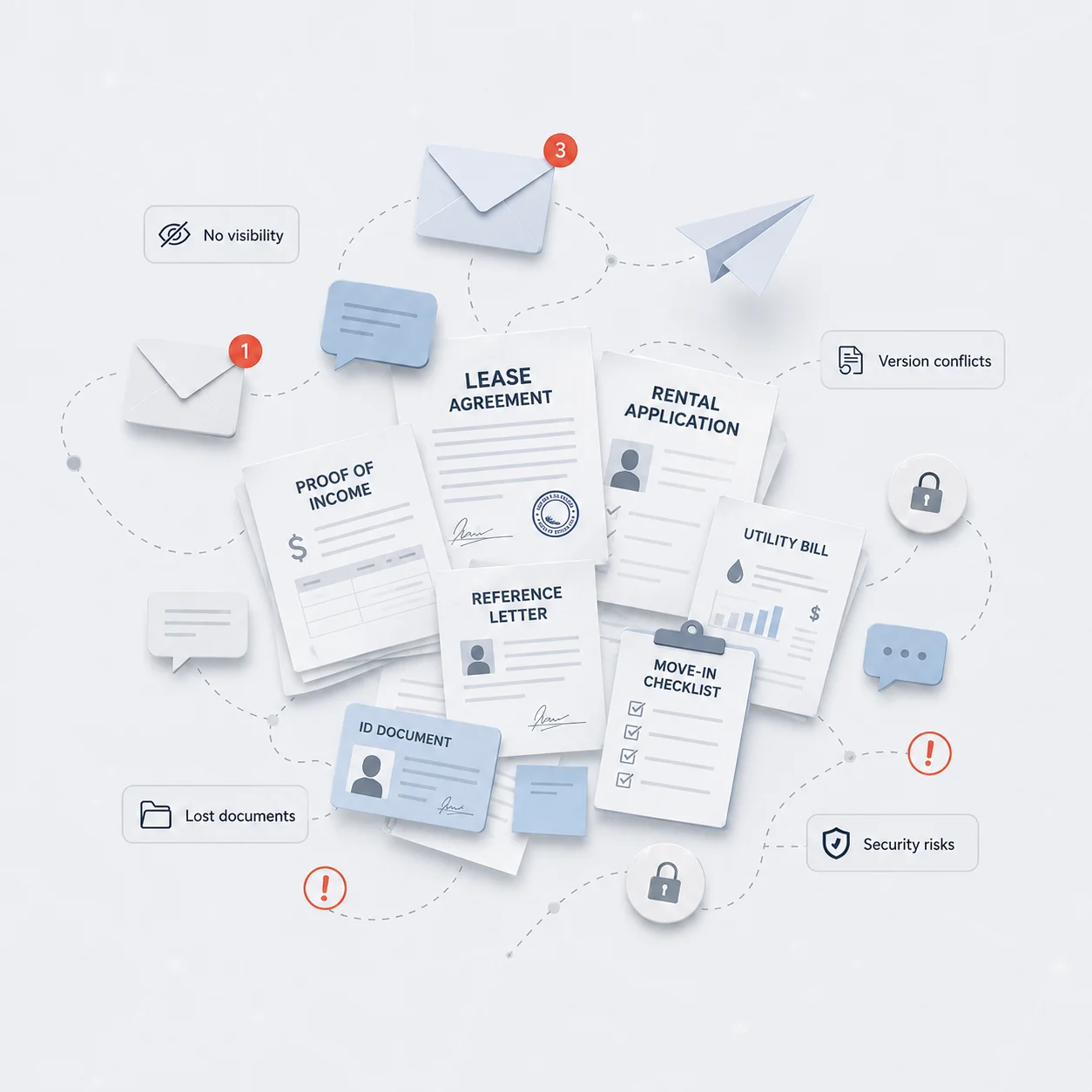
Email makes multi-party tenant referencing harder to coordinate.
Spreads sensitive tenant records across agent inboxes, landlord threads, and local downloads.
Centralize documents but often provide broad access to mixed identity, financial, and legal records.
May receive files without showing request purpose, reviewer status, or who still needs access.
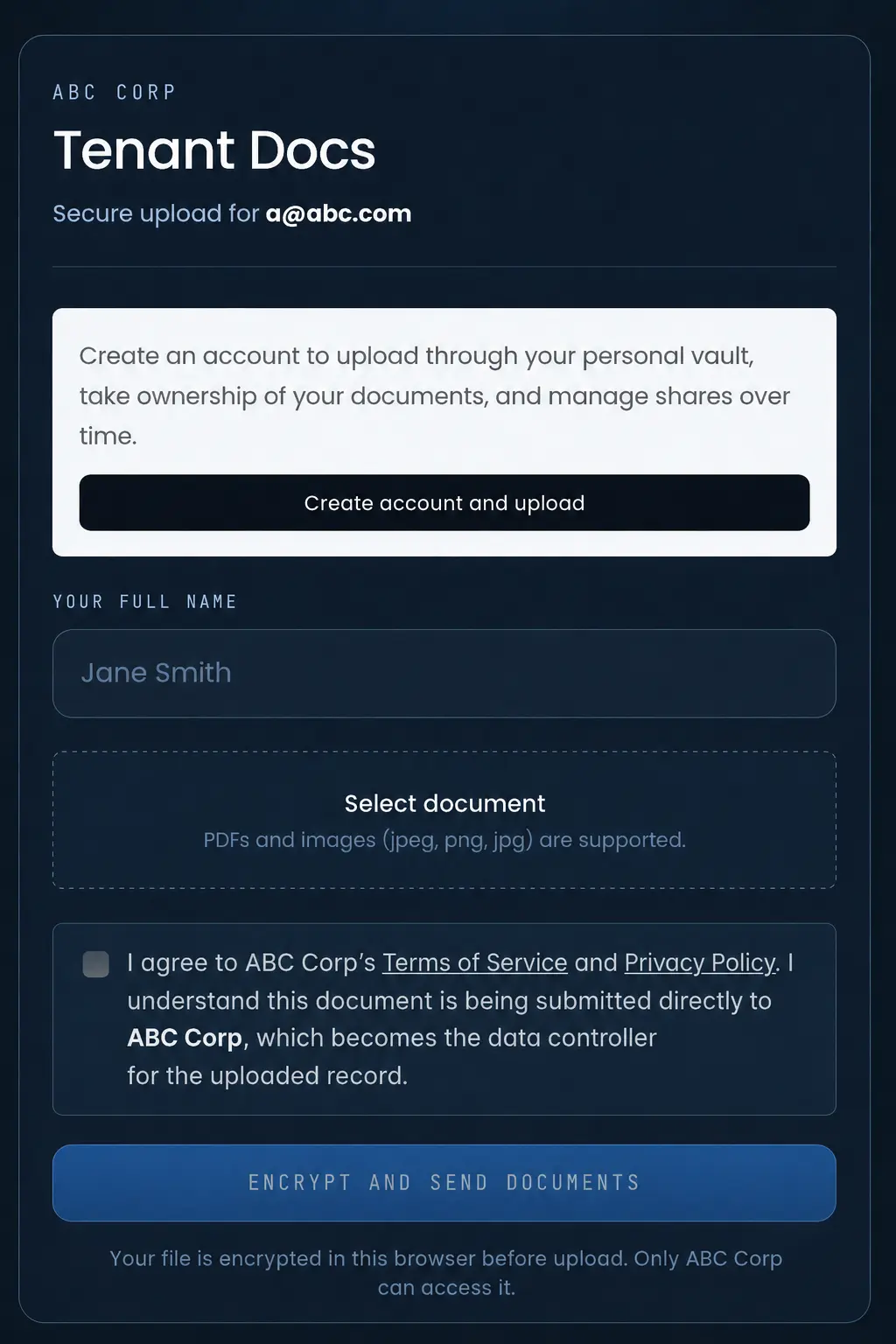
Tenant document collection from first request to referencing review.
Issue document requests tied to the tenancy, property, applicant, or legal workflow.
Receive sensitive tenant, landlord, or property records through a governed portal.
Give agents and authorized reviewers a clear record of what arrived and what remains missing.
Apply access controls, audit logging, and retention rules after the workflow closes.
Clearer custody across agents, landlords, applicants, and reviewers.
Audit trail
Record request, submission, access, review, and lifecycle events.
Scoped access
Limit bank statements, passports, and right to rent records to the right participants.
Document refresh
Collect updated references, evidence, or corrected documents without thread sprawl.
Applicant confidence
Give tenants and applicants a credible way to share highly personal records.
CVOR Data Room
When a deal has more parties than a tenancy.
A sale, a portfolio transaction or a block handover involves agents, solicitors on both sides, surveyors, lenders and the owner, each needing a different slice of the same pack. CVOR Data Room scopes a room to the transaction so every party is admitted on its own terms.
Parties
Buyers, lenders and surveyors, each with their own view
Interested parties can be admitted to the same room without seeing one another's submissions. Permissions change as a deal narrows from several bidders to one buyer.
Exchange
Collect the pack and release it from one room
Title documents, EPCs, surveys and compliance certificates are requested from whoever holds them and released to the parties who need them, under one set of controls.
Accountability
A record that outlasts the completion date
Access can be withdrawn when a deal closes or falls through, while the account of who was admitted and what they opened stays available afterwards.
Designed around property record handling and privacy obligations.
Property workflows may involve UK GDPR obligations around personal data handling. Right to Rent checks under the Immigration Act 2014 require landlords and agents to handle evidence in line with the applicable checking process.
CVOR does not determine whether a document should be collected or how a legal check should be performed. It provides a governed intake and custody layer for defined property workflows.
Property document workflow questions
Can CVOR support right to rent document workflows?
CVOR can provide a governed intake path and audit trail for right to rent evidence handling where the organization has defined its checking process.
What tenant referencing documents can CVOR collect?
CVOR can support tenant IDs, proof of income, bank statements, employer references, right-to-rent evidence, previous landlord details, and guarantor documentation.
Can multiple applicants and guarantors submit documents?
Yes. Property teams can issue scoped requests to the relevant participants while keeping submissions connected to the tenancy or referencing workflow.
Can CVOR be used as a data room for a property transaction?
Yes. CVOR Data Room scopes a room to the transaction, so agents, solicitors on both sides, surveyors, lenders and the owner can each be admitted with their own access. Permissions can change as a deal narrows from several interested parties to one buyer.
Move property document workflows into governed custody.
Sales-led onboarding. We assess document types, reviewer roles, access boundaries, and retention requirements before onboarding.