Access
Access set per party
Bidders, advisers, opposing counsel and internal reviewers can be admitted to the same room and given different views of it. Access is set per participant and changes as the transaction moves.
CVOR for Enterprise
Every request is a named item with its own status, so your team can see what is still outstanding without reading a thread — and explain who accessed a passport or payroll file long after the work closed.
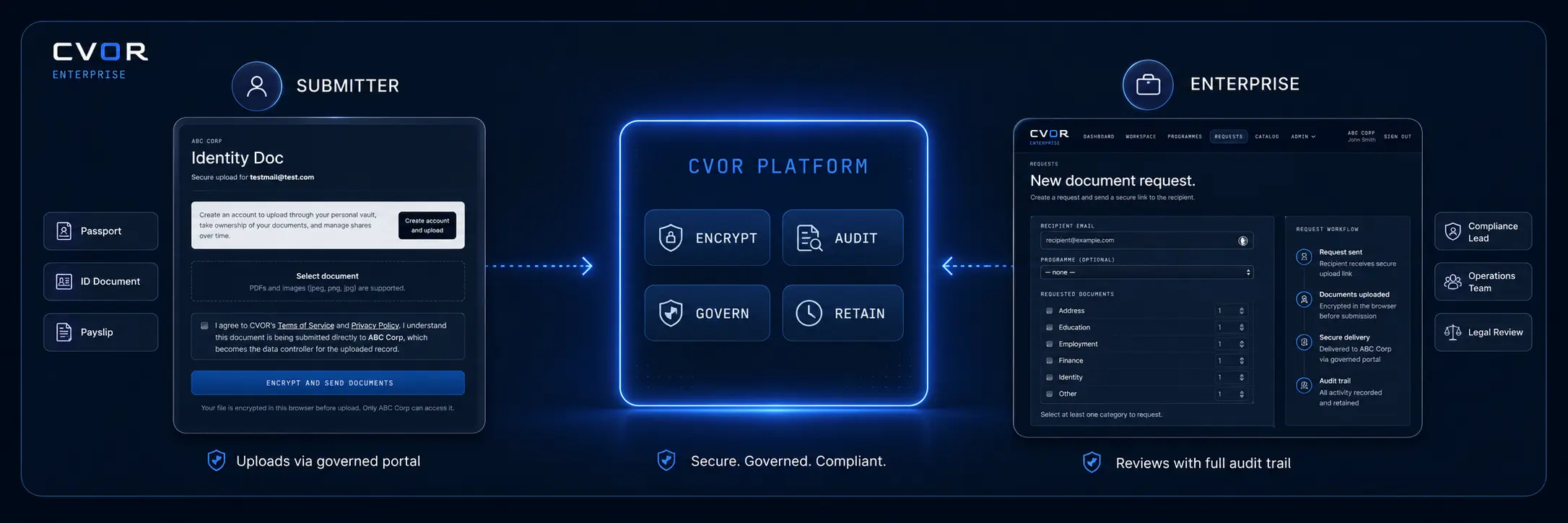
CVOR separates the personal side of a document exchange from the enterprise side. Submitters interact with a controlled portal designed for clarity and trust. Enterprise teams operate inside a tenant-scoped environment where access, review activity, retention, and audit evidence are governed by the platform — not by inbox conventions.
A scoped invitation is issued for a specific workflow. Access is explicit before any documents are requested.
The platform issues a structured document request — specific document types, clear requirements, governed intake.
The submitter uploads through the governed portal. Files are encrypted at the application layer on receipt.
The enterprise team reviews within the platform. Every access event is recorded in the immutable audit trail.
Retention rules, access controls, and lifecycle governance are enforced automatically from point of receipt.
CVOR Data Room
Some workflows are not one requester and one submitter. A transaction brings in bidders, opposing counsel, advisers and internal reviewers, each of whom should reach a different part of the same file. CVOR Data Room applies the same custody model to that shape: a room scoped to the transaction, where documents are requested from participants and released to them under one set of controls.
Room administrators decide who is admitted and what each party can reach. A legal firm acting for one side does not see what another side submitted, and an invited bidder sees only the material released to them.
Access
Bidders, advisers, opposing counsel and internal reviewers can be admitted to the same room and given different views of it. Access is set per participant and changes as the transaction moves.
Direction
A room collects evidence through named requests and releases material back to participants. Both halves carry the same access boundary and produce the same record of who did what.
Attribution
Material released from a room can carry recipient watermarking, so a document that travels beyond its intended reader remains traceable to the participant it was issued to.
Lifecycle
Transactions end. Access can be withdrawn, material retained under policy, and the account of who saw what kept after the room itself is no longer active.
The Data Room uses the same request, access and retention model as the rest of CVOR, with the boundary drawn around a transaction and every party in it.
Each layer governs a different dimension of risk. Together they form a system you can walk an auditor through.
Every workflow begins with a scoped invitation to a named person. There is no open registration link and no shared upload URL. Before a single document is requested, access is explicitly granted to the right person for the right workflow. Per-tenant authorization keeps every organization's records entirely separate. No document from one tenant is ever visible to another.
Sensitive personal information is encrypted at the application layer using AES-256-GCM before it reaches object storage. Documents, signed agreements, and personal data are never stored in plaintext. The platform acts as a governed control layer between the submitter and the storage system — not a pass-through.
Every upload, document view, status change, forwarding event, and lifecycle action is captured in an immutable, append-only audit log. Failed asynchronous events are isolated in a dead-letter system for controlled recovery — they do not silently disappear from the workflow record. When an auditor asks what happened, the answer is already there.
Document retention policies are enforced automatically through scheduled retention sweeps, so no one has to remember to delete records. Session expiry controls reduce standing access. Lifecycle decisions are governed by policy, not inbox management.
Every platform access point requires multi-factor authentication. Password hashing uses modern adaptive algorithms. Rate limiting on sensitive endpoints reduces exposure from automated attack attempts. Security headers and browser hardening are applied across the application.
CVOR's governance model maps technical controls to the questions procurement, compliance, and legal teams ask during review.
Controls aligned to ISO 27001 across access, cryptography, logging, retention, monitoring, and incident response.
Architecture follows GDPR Article 5 principles: purpose limitation, data minimisation, storage limitation, integrity, and accountability.
A traceability matrix connects controls to implementation evidence — designed to support procurement review conversations.
The platform includes an ISO 27001-aligned governance pack with a traceability matrix that connects controls to implementation evidence across access control, cryptography, logging, retention, monitoring, and incident response. This language describes architecture and governance intent — it does not claim a certification.
Review the full security posture →CVOR is usually assessed alongside existing channels, internal repositories, generic portals, and workflow-specific operating requirements.
Use this when the team needs to align on why ordinary channels cannot provide document-level governance.
Category fit Compare CVOR with file sharing and portalsUse this when buyers are evaluating Dropbox, Google Drive, shared drives, email attachments, or generic client portals.
Software evaluation What to look for in a secure document collection portalUse this when the team is comparing intake portals, upload links, and governed collection requirements.
CVOR serves both sides of the document exchange — the enterprise governing what it receives, and the individual controlling what they send.
Name the document types, workflow purpose, and submitter requirements through the governed platform.
Accept documents through the governed intake flow — no email attachments, no consumer messaging channels.
Every review action is recorded. Access is scoped. The audit trail is immutable from point of submission.
Retention, access controls, and lifecycle rules apply automatically once documents are in custody.
A specific invitation for a specific workflow — not an ambiguous request to email sensitive files.
Documents are uploaded with clear context around what is required and why it is being collected.
A clear record of what documents were submitted, to which organization, and when.
Receipt is confirmed — no uncertainty about whether a sensitive document arrived safely.
CVOR onboarding is sales-led so governance, document types, and operational constraints are understood before rollout.